Wednesday, October 25, 2017

shawn-atleo-1 

Shawn Atleo said he’s in a rebuilding phase just like the Canucks! After more than a decade in elected politics serving over 600 First Nations from all across Canada as the BC Regional Chief (03-09) and then National Chief of the Assembly of First Nations (09-14), Atleo shared some of his learning and insights at a recent Lunch & Learn session at the Shaqthut Gathering Place at VIU (March 8th, 2016).

Atleo is a heriditary Chief from Ahousaht First Nations off the west coast of Vancouver Island. As a resident of a rural remote west coast community, Shawn asked himself ‘how is it that a Norwegian owned, Chilean run fish farm filled with Atlantic salmon opened up beside their village?’ So he started to get involved in activism which then led to politics and trying to make a difference.

Shawn’s father Richard Atleo, also a Hereditary Chief of the Ahousaht First Nation, is recognized as the first Aboriginal person in British Columbia to earn a doctoral degree at the age of 50. Shawn himself pursued an International Masters of Education in Adult Learning and Global Change that was partnered through 4 post secondary institutions from Sweden, South Africa, Australia and UBC. That’s where he learned about the term ‘hegemony’ whereby norms, philosophy and ways of thinking are blanketed over institutions so that they almost act like nation states. “The mainstream of society has many institutions working for them”. Shawn now holds at least 8 honorary doctorate degrees from various Canadian universities including Universities of Ryerson, Queens, New Brunswick, Guelph, Cape Breton and Nippising to name a few.

In January 2004, new to his role as National Chief of the Assembly of First Nations, Shawn was asked by Prime Minister of Canada Paul Martin to attend a Special Summit of the Americas in Monterray Mexico with Presidents and Prime Ministers including George Bush and Hugo Chavez (President of Venuzuela). Even though one of the topics was Indigenous People’s, Shawn said he was the only Indigenous person there!

In 2007 Atleo marched in his Nuu-chah-nulth regalia along with 24,000 people in India, including poor farmers, landless workers and Indigenous peoples, to highlight land rights (or lack thereof) and the plight of those marginalised by India’s economic boom. It was a month long 600-kilometre (370-mile) journey from the central city of Gwalior to Dehli where 10 people died.

Shawn believes that Indigenous Peoples’ are on a come-back trail and some of the examples he gave include that First Nations in Canada have won 170 court cases across Canada to date, mainly against big business and resource extraction in traditional territories. The Chilcotin have 1700 square kilometres of their land recognized as title land; BC’s First Nations signed a ‘Health Accord’ in 2005 to transfer responsibility from Health Canada to local communities, in 2008 Prime Minister Stephen Harper issued a National apology to former residential school survivors and there are 94 recommendations in the Truth and Reconciliation report.

“Even though these are big steps in the right direction there is still so much work to do”, said Atleo. For example, even though the Nuu-chal-nulth have won their fishing rights in 2009 in the BC Supreme Court, they are still having to prove their rights in a ‘justification to negotiate their rights to sell fish. And the six Chilcotin Chiefs who were tried and hanged as murderers in 1864 after coming to what they thought would be peace talks, have yet to be exonerated.

From 2008 to 2014, Atleo was named Chancellor of VIU, becoming the first university chancellor of Aboriginal heritage in the province’s history. He is currently the ‘Shqwi qwal’ or speaker for Indigenous Dialogue housed in the Centre for Pre-Confederation Treaties and Reconciliation at VIU and supported by the provincial government. According to Shawn, VIU is the first institution in Canada to recognize elders as Faculty.

Atleo said that Universities must become more than institutions that develop human capital for a market economy. “What’s needed is institutional transformation to help develop civil society, supported by leadership but driven by the grassroots. Because only when we’re safe can we explore and have the vulnerability to make mistakes and learn from them so that innovation can arise” he said. He concluded his talk with a question “what can we do to support safety so we can explore, make mistakes, learn and innovate?”

Where Have All the Leaders Gone?

IMG_5966

Ken Hammer, former Vancouver Island University Faculty of Management member is wondering “where have all the leaders gone?” Ken gave a presentation and led a discussion about this question at a recent presentation sponsored by the Research and Scholarly Activity office at VIU.

In 2015 Ken attended an International Leadership Association Conference in Barcelona where one of the speakers challenged the audience to solve three of the world’s main challenges when it comes to leadership: greed, anger and hatred and ignorance. For the rest of the Conference Ken looked for the answers to these challenges and has been pondering this question ever since.
Ken has been teaching about leadership since 1982 and is a founder of Leadership Vancouver Island.

He wonders why these problems are still so prevalent when there are so many leadership programs the world over. Ken strongly feels that we have to start with youth leadership development and that opportunities like scouting and guides, boys and girls clubs that teach and promote leadership skills need to be more universally accessible.

Ken said that youth leadership needs to be value based, have lots of opportunity for ‘learning by doing’, should empower individuals gifts and talents, should be focused on collaboration and should value civility, citizenship, kindness and giving. Ken is currently working with the Brechin Elementary School youth leaders on a partnership program with a school in Africa, via skype, so that the kids can learn about what a week of life looks like for kids from another country. “The kids from Africa are amazed that the kids here get to skateboard and play video games after school instead of household chores and vice versa”, said Ken.

And then youth leadership needs to continue into adulthood. It needs to be practiced, reflected upon, and relationships need to be built on collaboration and caring. “And while leadership is important it’s only half the story”, said Ken, “followership is also critical”.

Ken concluded his presentation with a reminder that any solutions need to start with ourselves. His top five tips for becoming better leaders includes:
  1. getting over ourselves;
  2. understanding the reality of others and responding in ways that appreciate and nurture them;
  3. being courageous and challenging our fears;
  4. to become better followers and finally
  5. to come from a place a love or what Ken refers to as getting our daily requirements of Vitamin L. 
Ken Hammer has recently redirected from his role as a faculty member in the Faculty of Management at VIU so he can explore these and other important life questions. He continues to do work in the local and international communities through Startup Nanaimo, Ken Hammer & Associates, Nanaimo Daybreak Rotary and the Brong Ahafo Research and Extension Centre in Ghana.

Monday, June 20, 2016

What Makes a Community Healthy? 


Check out this Word Cloud made from survey responses from a survey I administered in the Alberni Clayoquot Regional District. 

Top five responses include:
Wordle: What Makes a Community Healthy?
  • Community
  • Opportunities
  • Services
  • Health
  • Access


Now, let's compare that to an info graphic published by Sparc BC about the top priorities and concerns for this region in 2015:

Top five include:
  • Income
  • Childcare
  • Employment
  • Housing
  • Education 


Conclusion: healthy communities at minimum provide opportunities for people to:

1. work and receive living wages
2. live in affordable and safe housing
3. have access to basic services like childcare and health
4. take education seriously.

Monday, February 1, 2016

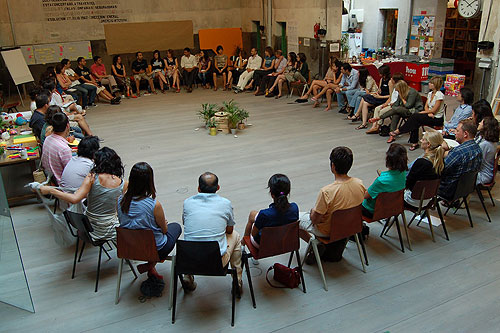
Collective Creativity Through the Art of Hosting

-->
I sometimes feel overwhelmed by the magnitude of challenges and need for change and my seeming lack of ability to affect the world in a positive way. When I think how to contribute to some of the local and global issues of our time, I often think about the words of Albert Einstein who said that we can't solve problems by using the same kind of thinking that created them. He also said that the challenges of these times call for 'collective intelligence'. In other words - we need groups of people to work together to come up with innovative solutions.

So, if what's needed today is 'collective intelligence', then we also need to ensure that there are deliberate opportunities for folks to come together to build trust and to listen to one another in order to co-create strategies for positive change. Because we not only need to be working across cultures, disciplines and silos, but we also need to be working across generations and even sometimes, just across the hall.

A great way of bringing folks together is through social technologies such as the 'Art of Hosting': a broad scope of gathering methodologies such as Open Space, World CafĂ©, Circle Practice and Appreciative Inquiry. 
http://www.artofhosting.org/wp-content/uploads/2013/03/DSC_0488.jpg

The 'Art of Hosting' is a practice that accesses and cultivates the power of collective intelligence to move a group toward meaningful conversation and wise action. It is a way of not only bringing people together but also of 'being together' so that individuals, organizations and communities can discover purposeful strategies and innovations that encourage change.

The idea of 'hosting' is based on values of inviting, welcoming and holding space for authenticity, intention and attention. Taken to an artful level it encompasses a way of being with others and situations as they unfold - of not only welcoming but actively and appreciatively inquiring into whatever seems to be important to the group at the time.

Perhaps Rumi's poem The Guest House best captures the spirit of the Art of Hosting when he tells us to "welcome and entertain them all!" (who-ever shows up), to "meet them at the door laughing and invite them in", to "treat each guest honorably" and to be "grateful for whoever comes, because each has been sent as a guide from beyond."

Some of the essential principles associated with 'Art of Hosting' practices are that:
* Whoever comes is the right people
* Whatever happens is the only thing that could have happened
* When it starts is the right time
* When it's over it's over

As well, it espouses the 'Law of Two Feet' whereby “if you find yourself in a situation where you are neither learning or contributing, go somewhere where you can.”

According to Chris Corrigan, author of an open source book called The Tao of Holding Space, as hosts our role is "to facilitate the flow of collaboration, to care for the small intangibles, the space, the quality of the invitation, the integrity of the offering." "All the potential for change," he says, is "in the room" and that holding space is an act of courage and leadership.

If nothing else, coming together for meaningful conversation helps me feel more connected to others, less overwhelmed, less alone, in short more hopeful that I can make a difference as part of a collective. We can all explore the practice of hosting and holding inspired and meaningful conversations that matter to us whether it be in our work, communities or personal life.

Guidelines for hosting Quality Conversations:

Conversation comes from the Latin con versare: turn or to dance together.
  • Stay present & suspend judgment … as best you can
  • Listen closely...with the intent to learn something; use silence to allow reflection and learning
  • Ask powerful questions … What do you envision? What would that mean to you? Tell me more
  • Propose rather than oppose … say what you want rather than what you do not want
  • Invite options & respect diverse opinions … What alternatives are there?
  • Speak what has personal importance and meaning … "I think/want/like"
  • Pursue honesty and depth … without going on and on
  • Allow all voices to be heard so the collective intelligence can surface
  • Focus on the present (what could we do now?) or the future (how might that look?) … rather than the past
  • Do not fear chaos - it is creative space where the innovation can be born

Resources:
www.openspaceworld.org/news/join-us/

www.archive.org/details/TheTaoOfHoldingSpace

Monday, January 25, 2016

Building Strong Communities


-->
Jim-Diers
“It’s the end of the world as we know it and I feel fine”, REM

According to Jim Diers, Community Development guru from Seattle, there’s a difference between ‘community’ and ‘neighborhood’. Neighborhood refers to a geographical place and community refers to our social connections. In some cases we have ‘community’ in our neighborhoods, but not always. More often than not our most vibrant community connections are through our work, sports activities, common interests, religion etc.

So how do we build community connections in our neighborhoods? Jim Diers says that there are several keys to creating community. For one thing, gathering places are essential, providing folks with opportunities to bump into one another. We also need to make community life fun and more engaging than television.

As community developers, it’s vital that we start where people are at and empower them to develop and work on dreams for their community rather than imposing what we think is best. After all, communities are ripe with talented and passionate people to tap into.

We also need to take a ‘cup is half full’ approach by building on the assets in communities versus the typical institutional approach of focusing on what’s wrong or missing and then looking to the outside for answers and to quick ‘fix’ the deficiencies. Too often we are defining people by their disabilities (at-risk, homeless, isolated, low-income) instead of on their gifts. Jim says that every individual has gifts of the head, heart and hands.
Community asset mapping is a great process for taking stock of what already exists in community to build on.

According to Diers, every place has a plethora of assets to tap into and build on including:
  • Gifts of individuals
  • Voluntary associations
  • Built and natural environment
  • Local economy
  • Local heritage and identity
  • Local agencies.

As well, Diers says that local agencies in particular are underutilized because they aren’t democratic. Schools for example have incredible resources that community could tap into after hours yet very few schools are able to function as true ‘community schools’. There is a disconnect between ‘community’ and ‘school’ even though learning is life long and occurs in the context of community itself.

Finally Diers identifies steps toward effective agency/ community partnerships including:
1) Do no harm. In other words don’t distract or undermine community, don’t waste their time and don’t create dependency. The iron rule he says is to “never do for people what they can do for themselves”.
2) Remove Agency Barriers including: centralized decision making, cookie cutter programs and regulations that don’t serve, rigid silos and departments, bureaucratic red tape and the know it all attitudes.
3) Build Community Capacity: including focus on leadership development, out reach, networking, matching funds.

Monday, March 2, 2015

Better Together…Building Social Capital

-->
By flying in a “V” formation, a flock of geese gains at least 71% greater flying range than if each goose flew on its own. 

From 1996 – 1998 I lived and worked in Jakarta, Indonesia as a ‘cooperant’ with CUSO, a Canadian international development agency that sends folks to work in grassroots community development projects and are paid local wages. During my time there the country fell into severe financial hardship, referred to now as the ‘Asian Economic Crisis’, that crippled the country with a ten fold currency decline, banks closures and overnight price increases for staple items like rice and fuel that ultimately led to a people’s revolution and overthrow of a 35 year dictatorship.

The biggest thing that I noticed during this chaotic time was how the people in the cities were the ones most deeply affected by the crisis. In contrast, when I traveled out to the rural areas – to places where people still grew their own food, bartered bananas for chicken, and were still connected to and looked after one another, were fine. Though country folk had few financial assets, they had incredible wealth in their communities. What they had a lot of was ‘social capital’.

What is social capital?

In a nutshell, social capital refers to the resources that are available to us because of our relationships – whether they be familial, friendly or professional: formal or informal. And the resources are plentiful including information, ideas, leads, products, food, money, power, emotional support, goodwill, trust, cooperation and more.  The denser the networks, the more likely that it’s members will cooperate and share resources for mutual benefit.

Research has shown that higher levels of social capital are associated with better health, higher educational achievement, better employment outcomes, lower crime rates, longer lives. And it also leads to happiness. After twenty five years of psychological research on happiness, University of Chicago psychologist Mihaly Csikszentmihalyi found that two factors matter more than anything else – meaningful work and relationships with others. In other words, those with extensive networks are more likely to be healthy, housed, hired and happy.

Building networks is a major way of participating in the world and enables us to contribute to the lives of others. By doing so we not only reap the personal benefits of networks, we make the world a better place by making it a more connected place. In practice, “using” social capital means putting our networks into action and service for others.

Different types of social capital can be typically described as:

Bonding – related to 'getting by' in life and is characterized by strong bonds among family members, closely knit friendship ties, religious and ethnic groups etc. (Folks that regularly share their resources with you).

Bridging – helps with 'getting ahead' in life and is characterized by weaker, but more cross-cutting connections with acquaintances, associations, friends of friends, etc. (Folks  that might give you a lead on a job, a discount on mechanical work etc.).

Linking – helps with ‘accessing power’ and is characterized by connections with people in different positions of power and is good for accessing support from formal institutions. (Folks that you can call on who might be in a position to help with your cause).


10 Ideas for Building Social Capital:

  • Schedule a half an hour “get together” before meetings.
  • Bring a healthy home cooked food item to meetings (e.g. fresh baked muffins. You’ll be a star!).
  • Consciously think about being a bridge builder – who else can you invite ‘to the table’ that could benefit and contribute?
  • Think about how to involve different types of volunteers in your work, and also think about how you can volunteer.
  • Form informal social groups —softball teams, hiking clubs, book circles, potluck clubs, etc.
  • Participate in your local community events. Better yet – help to organize them!
  • Have a movie night at your house or organization—with popcorn during and discussion afterward.
  • Try this recipe for network building: take one good reason to come together + great people. Mix them together in a nice space and add some great food and beverages and watch what happens!
  • Invite local government officials to have lunch and a topical discussion with one of your networks.
  • Hold discussions about social capital, and what you can do to help increase it in your life, in your work, in your community.

Links to Web Resources on Social Capital:


Monday, June 4, 2012

Why Building Effective Networks Leads to Building Healthier Communities.

Transformation that leads to healthy communities is the result of many interactions and collaborations among many people. When different people from different sectors get together, entirely new solutions can and do arise. This phenomenon is what scientists refer to as emergence. According to Wikipedia, emergence is when complex systems and patterns arise out of a multiplicity of relatively simple interactions. Emergence is what can and does happen among networks and it is the diversity of interactions that are critical to doing so.

So what does a vibrant, effective community network that fosters emergence look like? Scientists, sociologists, mathematicians and management consultants have all discovered similar characteristics about networks whether they be made up of people in organizations, cells in a nervous system, molecules in protein interactions, or routers and servers on the internet.

1. They share common attributes, goals or governance.
2. There is a diversity of connections that are vital for maximizing innovation.
3. There are several communication paths in order to maintain uninterrupted information flow in case any single path goes down.
4. There are prominent 'roles' that are critical to the health of the network that help to keep everything moving/ flowing.
5. They are fast to facilitate indirect linkages.

Clay Shirky, new media guru, says that networks are the new 'institutions' except without all the baggage. In the past, when groups of people wanted to organize in order to do stuff, they had to build the infra-structure to do so (i.e. organizations with staff, offices, management, flow charts, rules, hierarchy etc.). But now, you can organize to do stuff apart from the limits of institutions via 'networks' whereby people coordinate to do stuff not because they have to, but because they want to and because they can be more effective at getting stuff done.

According to social theorist Jonathon Zittrain, the internet is a massive network that relies on kindness and trust. Random people everywhere conduct random acts of kindness everyday by simply passing information along. And according to collective intelligence theorist George Por, networks help build the capacity of human communities to evolve towards higher order complexity and harmony (a.k.a. emergence).

Finally, it's important to note that the most effective networks have active leaders who take responsibility for building the network. Without active leaders, networks emerge very slowly or not at all and can end up as small groups with like-minds, with little or no diversity and no possibility for new ideas and innovation.

In order to build healthier communities, networks need to be fostered and supported so that emergence can truly occur.