I sometimes feel overwhelmed
by the magnitude of challenges and need for change and my seeming lack of ability
to affect the world in a positive way. When I think how to contribute to some
of the local and global issues of our time, I often think about the words of
Albert Einstein who said that we can't solve problems by using the same kind of
thinking that created them. He also said that the challenges of these times call for 'collective intelligence'. In
other words - we need groups of people to work together to come up with
innovative solutions.
So, if what's needed today is 'collective
intelligence', then we also need to ensure that there are deliberate
opportunities for folks to come together to build trust and to listen to one
another in order to co-create strategies for positive change. Because we not
only need to be working across cultures, disciplines and silos, but we also
need to be working across generations and even sometimes, just across the hall.
A great way of bringing folks
together is through social technologies such as the 'Art of Hosting': a broad
scope of gathering methodologies such as Open Space, World Café, Circle
Practice and Appreciative Inquiry.
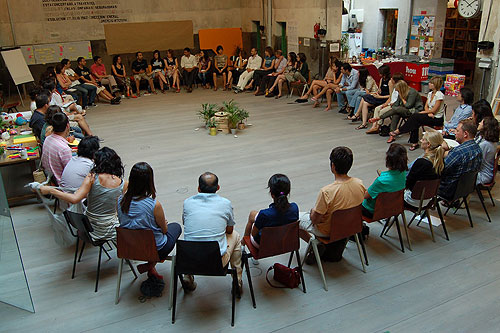
The 'Art of Hosting' is a
practice that accesses and cultivates the power of collective intelligence to
move a group toward meaningful conversation and wise action. It is a way of not
only bringing people together but also of 'being together' so that individuals,
organizations and communities can discover purposeful strategies and
innovations that encourage change.
The idea of 'hosting' is based on values of inviting,
welcoming and holding space for authenticity, intention and attention. Taken to
an artful level it encompasses a way of being with others and situations as
they unfold - of not only welcoming but actively and appreciatively inquiring
into whatever seems to be important to the group at the time.
Perhaps Rumi's poem The Guest House best
captures the spirit of the Art of Hosting when he tells us to "welcome and
entertain them all!" (who-ever shows up), to "meet them at the door
laughing and invite them in", to "treat each guest honorably"
and to be "grateful for whoever comes, because each has been sent as a
guide from beyond."
Some of the essential principles associated with 'Art
of Hosting' practices are that:
* Whoever comes is the right people
* Whatever happens is the only thing that could have
happened
* When it starts is the right time
* When it's over it's over
As well, it espouses the 'Law of Two Feet' whereby “if
you find yourself in a situation where you are neither learning or
contributing, go somewhere where you can.”
According to Chris Corrigan, author of an open source
book called The Tao of Holding Space, as hosts our role is "to
facilitate the flow of collaboration, to care for the small intangibles, the
space, the quality of the invitation, the integrity of the offering."
"All the potential for change," he says, is "in the room"
and that holding space is an act of courage and leadership.
If nothing else, coming together for meaningful
conversation helps me feel more connected to others, less overwhelmed, less
alone, in short more hopeful that I can make a difference as part of a
collective. We can all explore the practice of hosting and holding inspired and
meaningful conversations that matter to us whether it be in our work,
communities or personal life.
Guidelines for hosting Quality Conversations:
Conversation comes from the Latin con versare: turn or
to dance together.
- Stay present & suspend judgment … as best you can
- Listen closely...with the intent to learn something; use silence to allow reflection and learning
- Ask powerful questions … What do you envision? What would that mean to you? Tell me more
- Propose rather than oppose … say what you want rather than what you do not want
- Invite options & respect diverse opinions … What alternatives are there?
- Speak what has personal importance and meaning … "I think/want/like"
- Pursue honesty and depth … without going on and on
- Allow all voices to be heard so the collective intelligence can surface
- Focus on the present (what could we do now?) or the future (how might that look?) … rather than the past
- Do not fear chaos - it is creative space where the innovation can be born
Resources:
www.openspaceworld.org/news/join-us/
www.archive.org/details/TheTaoOfHoldingSpace
